
Object
To study and plot the V-I characteristics of a photodiode under different illumination conditions and observe the effect of light intensity on reverse current.
Apparatus Required
- Photodiode (Silicon photodiode)
- Regulated DC power supply (0–12 V)
- Digital multimeter
- Microammeter (0–500 µA)
- Voltmeter (0–10 V)
- Resistor (1 kΩ)
- LED or light source
- Breadboard and connecting wires
Theory
A photodiode is a semiconductor device that converts light energy into electrical current. It is generally operated in reverse bias condition.
When light falls on the photodiode, photons generate electron-hole pairs in the depletion region. These charge carriers produce photocurrent.
Working principle:
- In darkness, a very small reverse current called dark current flows.
- When light falls on the photodiode, reverse current increases.
- Higher light intensity produces higher photocurrent.
- The photocurrent is approximately proportional to the intensity of incident light over its operating range.
4. Circuit Diagram
A. Reverse Bias Photodiode Circuit

Connections:
- Connect the cathode (K) of the photodiode to the positive terminal of the DC supply through a current-limiting resistor and microammeter.
- Connect the anode (A) to the negative terminal of the supply.
- Connect the voltmeter in parallel with the photodiode.
- Arrange a variable light source facing the photodiode.
5. Procedure
- Identify the anode and cathode terminals of the photodiode.
- Connect the circuit in reverse bias configuration.
- Keep the photodiode in darkness and switch ON the DC supply.
- Increase the reverse bias voltage gradually from 0 V to 10 V.
- Record the reverse current at each voltage.
- Now illuminate the photodiode using a light source at a fixed distance.
- Repeat the experiment at different light intensities.
- Record the corresponding reverse current for each voltage.
- Plot the V-I characteristics for dark, low, medium and high illumination conditions.
6. Observation Table
A. Effect of Reverse Voltage on Photocurrent
Assumed experimental conditions: Silicon photodiode.
| S. No. | Reverse Voltage (V) | Dark Current (µA) | Low Light (µA) | Medium Light (µA) | High Light (µA) |
|---|---|---|---|---|---|
| 1 | 0 | 0.1 | 2 | 5 | 100 |
| 2 | 1 | 0.2 | 2.2 | 5.2 | 200 |
| 3 | 2 | 0.2 | 2.3 | 5.3 | 300 |
| 4 | 3 | 0.3 | 2.4 | 5.4 | 400 |
| 5 | 4 | 0.3 | 2.5 | 5.5 | 500 |
7. V-I Characteristics Graph
V-I Characteristics of Photodiode
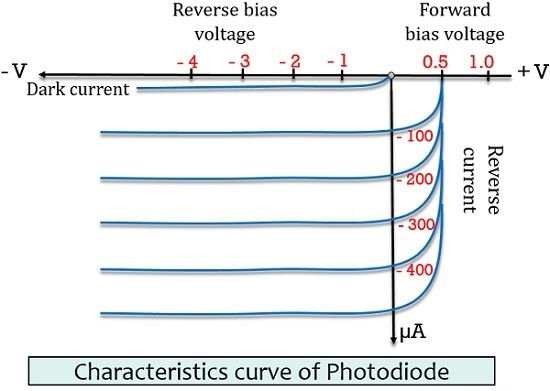
Graph interpretation:
- In darkness, only a very small dark current flows.
- Under illumination, reverse current increases.
- Higher illumination produces higher photocurrent.
- Photocurrent remains approximately constant as reverse voltage increases over the normal operating region.
- The graph demonstrates that photodiode current depends primarily on incident light intensity.
Result
The V-I characteristics of the photodiode were studied under different illumination conditions.
It was observed that the reverse photocurrent increases with an increase in incident light intensity. Thus, the photodiode converts light energy into electrical current.
Precautions
- Connect the photodiode in reverse bias.
- Check the polarity before switching ON the supply.
- Use a suitable current-limiting resistor.
- Do not exceed the maximum reverse voltage rating.
- Keep the light source at a fixed distance during each set of readings.
- Avoid unwanted external light during dark-current measurement.
- Use a microammeter of suitable range.
- Change illumination only after recording the previous set of readings.
Viva-Voce Questions
- What is a photodiode?
- What is the working principle of a photodiode?
- Why is a photodiode generally operated in reverse bias?
- What is dark current?
- What is photocurrent?
- What happens to photocurrent when light intensity increases?
- What is the function of the depletion region?
- What is the difference between a photodiode and an LED?
- What are the applications of a photodiode?
- What is the difference between a photodiode and a solar cell?
Applications of Photodiode
- Optical fiber communication receivers
- Automatic lighting systems
- Smoke detectors
- IR remote control receivers
- Light intensity measurement
- Barcode scanners
- Optical sensors